



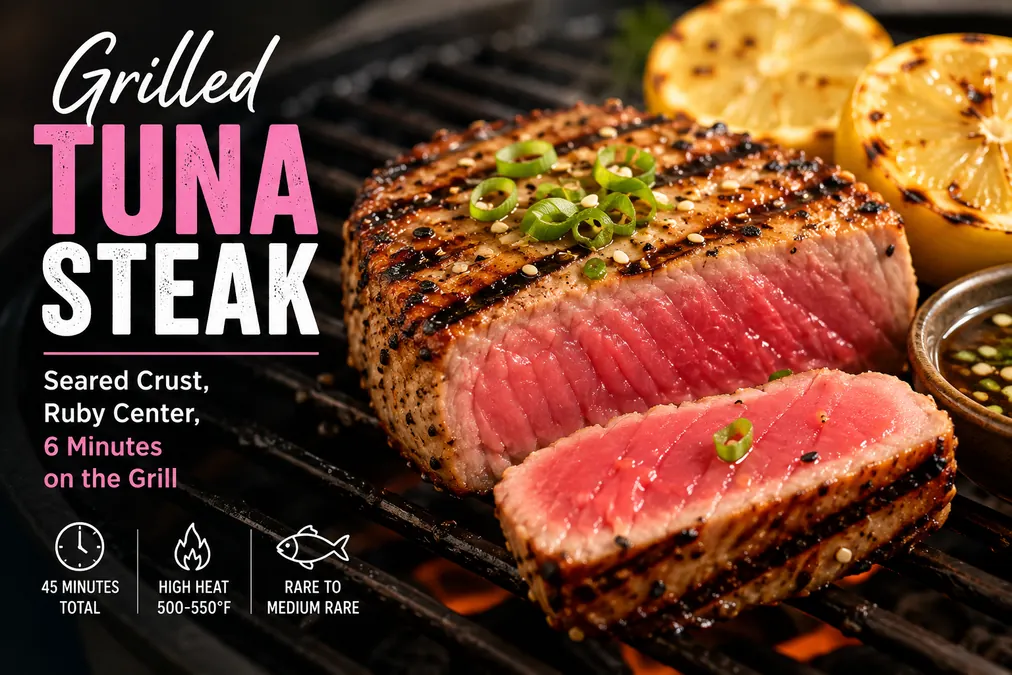
The best grilled tuna steak recipe uses a 1 to 1.5 inch thick ahi steak, a 30-minute marinade, and a screaming hot grill for 90 seconds to 2 minutes per side. That is it. Tuna is not a fish you cook through. It is a fish you mark hard on the outside and pull while the center is still deep pink, because tuna has almost no intramuscular fat to protect it, and past medium it turns dry and chalky in a way no sauce can rescue.
If you have overcooked tuna before, the cause was almost certainly one of three things: the steak was too thin to survive a proper sear, the grill was not hot enough so the fish cooked slowly all the way through, or you cooked to a timer instead of to thickness. This page covers the recipe, how to buy tuna that is worth grilling, the doneness math, three marinades, and the mercury and food safety questions people genuinely have before serving it.
Quick recipe facts
| Detail | Spec |
| Prep time | 10 minutes |
| Marinate time | 30 minutes |
| Grill time | 4 to 6 minutes total |
| Total time | 45 minutes |
| Yield | 4 servings |
| Best cut | Ahi (yellowfin) steak, 1 to 1.5 inches thick |
| Target doneness | Rare to medium rare |
| Grill temperature | 500 to 550°F, direct high heat |
| Diet | Dairy-free, easily gluten-free, paleo friendly |
How to buy tuna worth grilling
The single largest quality variable in this recipe happens at the fish counter, not the grill. A thin, pale, previously frozen steak will disappoint you no matter how well you cook it.
Look for these four things:
- Thickness of at least 1 inch. This is non-negotiable. A 1/2 inch steak cooks through before a crust ever forms. If the counter only has thin steaks, buy a whole loin section and cut it yourself.
- Deep, translucent color. Yellowfin should be rich red to pink and slightly glossy. Avoid steaks that look dull, brown at the edges, or matte.
- No gaping in the muscle. The flesh should be tight and even. Visible separation between muscle segments means the fish has been handled roughly or thawed and refrozen.
- A clean smell. Fresh tuna smells like almost nothing. Any sourness or strong fishiness is a hard pass.
One thing worth knowing: much of the tuna sold as fresh at American counters was frozen at sea and thawed at the store. That is not a defect. Freezing at sea, often to minus 60°F, preserves quality better than several days on ice, and it is also the process that addresses parasite risk in fish intended to be served rare.
Which tuna species should you grill?
| Species | Also sold as | Color and fat | Best use | Mercury level |
| Yellowfin | Ahi | Deep red, lean | Grilling, searing | Higher |
| Bigeye | Ahi | Red, noticeably fattier | Grilling, sashimi | Highest |
| Albacore | White tuna | Pale pink, mild, soft | Grilling, canning | Moderate |
| Skipjack | Light tuna, katsuo | Dark, strong flavor | Canning, stews | Lowest |
| Bluefin | Toro, maguro | Deep red, very fatty | Sushi, rarely grilled | Highest |
Yellowfin is the default for a reason. It is firm enough to hold together on grill grates, lean enough to take a hard sear without flaring, and widely available. Albacore is a good budget alternative but softer, so handle it gently.
According to the U.S. Food and Drug Administration’s advice on eating fish, yellowfin and albacore tuna fall into the “Good Choices” category, recommended at about one serving per week for sensitive groups, while bigeye tuna is on the list to avoid for people who are pregnant or breastfeeding and for young children. For sourcing and sustainability, the Monterey Bay Aquarium’s Seafood Watch program rates specific tuna fisheries and gear types, which vary widely even within the same species.
Master recipe: grilled ahi tuna steaks
Ingredients
Tuna
- 4 yellowfin (ahi) tuna steaks, 6 to 8 oz each, 1 to 1.5 inches thick
- 1 tablespoon neutral high-smoke-point oil such as avocado or grapeseed
- 1 teaspoon kosher salt
- 1/2 teaspoon coarse black pepper
Soy ginger marinade
- 1/4 cup soy sauce or tamari
- 2 tablespoons toasted sesame oil
- 2 tablespoons rice vinegar
- 1 tablespoon honey or maple syrup
- 4 cloves garlic, minced
- 1 tablespoon fresh ginger, grated
- 1 teaspoon chili garlic sauce, optional
- Zest of 1 lime
Finish
- 2 scallions, sliced thin
- 1 tablespoon toasted sesame seeds
- Lime wedges
- Flaky sea salt
Method
- Pat the steaks bone dry. Blot both sides with paper towels and press gently. Surface moisture steams instead of searing, and steamed tuna never develops the crust that makes this dish work. Do this even if the fish looks dry.
- Marinate for 30 minutes, not longer. Whisk the marinade ingredients, pour over the steaks in a shallow dish, and refrigerate. Thirty minutes is the ceiling here. The acid in the vinegar and lime begins denaturing the surface proteins beyond that point, giving you a chalky, ceviche-like exterior band before the fish ever touches heat.
- Preheat the grill hard. Bring the grill to 500 to 550°F with the lid closed, roughly 10 to 15 minutes on gas or until charcoal is fully ashed over and you can hold your hand 4 inches above the grate for only 2 seconds. Tuna is a fast, hot-fire fish. A medium grill will cook it through before it browns.
- Clean and oil the grates. Scrape the grates clean, then wipe them with a folded paper towel dipped in high-smoke-point oil, held with tongs. Repeat twice. Tuna is extremely lean and will weld itself to a dirty or dry grate.
- Dry the steaks again and oil the fish. Remove from the marinade, blot the surface a second time, then brush each steak lightly with oil and season with salt and pepper. Reserve the leftover marinade if you plan to make a glaze, and boil it for at least one full minute before it touches cooked fish.
- Grill 90 seconds to 2 minutes per side. Lay the steaks down and do not move them. Rotate 45 degrees at the one-minute mark if you want crosshatch marks. Flip once. For a 1 inch steak, 90 seconds per side gives rare. For 1.5 inches, go 2 to 2.5 minutes per side. Watch the side of the steak: a pale cooked band will creep up from the bottom, and you want to pull it when that band is roughly a quarter of the way up each side.
- Rest 3 minutes, then slice against the grain. Move to a board and rest briefly. Slice into half-inch pieces across the muscle fibers, which shortens them and keeps every bite tender. Scatter scallions, sesame seeds, and flaky salt, and serve with lime.
Doneness: the part that decides everything
Tuna doneness is a matter of seconds, not minutes. Use this as your reference.
| Doneness | Internal temp | Center appearance | Time per side, 1 inch steak | Verdict |
| Rare | 110 to 115°F | Deep red, cool center | 60 to 90 seconds | Ideal for most people |
| Medium rare | 115 to 125°F | Ruby pink center | 90 seconds to 2 minutes | Excellent |
| Medium | 125 to 135°F | Pink center, firmer | 2.5 to 3 minutes | Acceptable limit |
| Medium well | 135 to 145°F | Barely pink, dry | 3.5 minutes | Not recommended |
| Well done | 145°F and up | Opaque, chalky | 4 minutes plus | Buy canned instead |
An important distinction worth being straight about: the FDA recommends cooking fish to an internal temperature of 145°F for food safety, which is well past where grilled tuna is enjoyable. Restaurants and home cooks routinely serve tuna rare, and the risk is managed on the sourcing side, through commercial freezing at sea, rather than through cooking temperature. If you are serving someone pregnant, immunocompromised, very young, or elderly, cook to the FDA temperature or choose a different fish for them. That is a real trade-off and you should make it deliberately rather than by accident.
Carryover cooking is minimal in tuna because the steaks are thin and cook so briefly, so what you pull is close to what you serve. Pull at your target, not below it.
Three marinades that work
Tuna is mild and takes flavor readily, but its short marinating window means the marinade has to be assertive and hit fast.
| Marinade | Core ingredients | Flavor direction | Max marinate time |
| Soy ginger | Soy, sesame oil, rice vinegar, ginger, garlic, honey | Savory, aromatic, the default | 30 minutes |
| Citrus herb | Olive oil, lemon, orange zest, oregano, garlic | Bright, Mediterranean | 20 minutes |
| Chili lime | Lime, chili garlic sauce, honey, cilantro, cumin | Hot, sour, punchy | 20 minutes |
Two rules apply to all three. First, anything with significant acid needs a shorter window, because acid cooks the surface. Second, honey and sugar accelerate browning, which is helpful on a hot grill but means you need to watch closely for scorching. If you want to use the leftover marinade as a sauce, bring it to a full boil for a minute and reduce it slightly.
A no-marinade alternative: the sesame crust
Skip the marinade entirely, coat the dry steaks in a mix of white and black sesame seeds pressed firmly into all sides, and grill as directed. The seeds toast on contact and give you texture that a marinade cannot. This is also the most reliable option if your grill grates are temperamental, since the seed layer acts as a partial barrier.
Troubleshooting
| Problem | Cause | Fix |
| Dry and chalky | Cooked past medium | Pull at 115 to 125°F, use a thicker steak |
| Stuck to the grates | Dirty grate, or flipped too early | Oil the grate three times, do not move it for 90 seconds |
| No sear, gray exterior | Grill not hot enough, or wet surface | Preheat to 500°F plus, blot the fish twice |
| Cooked through despite short time | Steak was under 1 inch thick | Buy a loin section and cut your own steaks |
| Chalky band around the edge | Marinated too long in acid | Cap acidic marinades at 20 to 30 minutes |
| Falls apart when flipped | Albacore or an over-marinated steak | Use yellowfin, flip once with a wide spatula |
| Tastes flat | Under-seasoned after cooking | Finish with flaky salt and lime off the heat |
| Metallic or overly fishy | Fish was not fresh | Buy from a counter with turnover, smell before buying |
No grill? Three alternatives that work
| Method | Setup | Time per side | Result |
| Cast iron skillet | Preheat 5 minutes on high, smoking hot | 60 to 90 seconds | Closest to grilled, best crust |
| Grill pan | Preheat 5 minutes, ridges give marks | 90 seconds | Good marks, less char flavor |
| Broiler | Top rack, 4 inches from element | 2 minutes | Even cooking, no crust |
Cast iron is the strongest substitute and arguably produces a better crust than a grill, since you get full-surface contact instead of contact only where the grates touch. Ventilate the kitchen, because a properly hot pan searing tuna will smoke.
What to serve with grilled tuna steak
- Jasmine rice or stir-fried whole grain rice, which soak up whatever sauce you make from the marinade
- Cold glass noodles dressed in sesame, a strong warm-weather pairing
- A raw lettuce mix with a smoked vinaigrette to cut the richness
- Grilled or blistered vegetables that can share the same hot fire
- Sliced over a rice paper wrap with fresh herbs and a lime-ginger-peanut sauce
- A spicy garlic eggplant side, which gives you a soft, silky counterpoint to the firm seared fish
That last combination is the one we would push. Lean seared fish and creamy chili-glazed vegetable is a texture contrast that carries a whole plate.
Nutrition context
Grilled tuna is one of the more efficient protein sources you can put on a grill. According to USDA FoodData Central, raw yellowfin tuna contains roughly 109 calories and about 24 grams of protein per 100 grams, with very little fat. Most of the calories in a finished plate come from the marinade oil and any sweetener, not the fish.
Tuna also supplies omega-3 fatty acids, though leaner species like yellowfin carry meaningfully less than fattier fish such as salmon, sardines, or bluefin. If omega-3 content is your primary goal, tuna is a reasonable but not optimal choice. If lean protein is the goal, it is close to ideal.
Diet swaps
- Gluten-free: Replace soy sauce with tamari or coconut aminos. Check chili garlic sauce labels, since many contain wheat.
- Paleo and Whole30: Coconut aminos in place of soy, skip the honey, and lean on citrus and herbs instead.
- Low sodium: Low-sodium tamari, and salt only after cooking so you can taste as you go.
- No added sugar: Drop the honey. You lose some browning, so add 15 to 20 seconds per side.
- Pescatarian meal prep: Grill the steaks rare, cool fully, refrigerate, and slice cold over grains or greens within 2 days. Do not reheat.
Storage and leftovers
- Refrigerate cooked tuna airtight for up to 2 days. Tuna has a shorter safe window than most cooked proteins.
- Do not reheat. Reheating takes rare tuna straight to well done. Eat leftovers cold, sliced thin over rice, noodles, or salad. Cold seared tuna is genuinely good, which is not true of most reheated fish.
- Freezing cooked tuna is not worth it. The texture degrades badly. Freeze raw steaks instead, wrapped tightly, for up to 3 months, and thaw overnight in the refrigerator rather than at room temperature.
- Marinade can be mixed up to 5 days ahead and refrigerated. Never reuse marinade that touched raw fish without boiling it first.
FAQs About Grilled Tuna Steak Recipe
How long do you grill tuna steaks?
Grill tuna steaks 90 seconds to 2 minutes per side over direct high heat at 500 to 550°F for a 1 inch thick steak, which produces a rare to medium rare center. A 1.5 inch steak needs 2 to 2.5 minutes per side. Judge by the cooked band creeping up the side of the steak rather than by the clock alone, and pull when it reaches about a quarter of the way up.
Can you eat grilled tuna rare?
Rare tuna is served routinely in restaurants and homes, and the safety of it is managed at the sourcing stage rather than by cooking temperature. Most commercial tuna is frozen at sea, which addresses parasite risk. The FDA still recommends cooking fish to 145°F, so for pregnant, immunocompromised, elderly, or very young diners, cook it through or serve a different fish.
What temperature should grilled tuna be inside?
Aim for 110 to 115°F for rare and 115 to 125°F for medium rare. Past 135°F, tuna loses moisture rapidly and turns dry and chalky because it has almost no intramuscular fat to compensate. Carryover cooking is minimal in a steak this thin, so pull at your target temperature rather than below it.
How do you keep tuna from sticking to the grill?
Clean the grates thoroughly, then oil them three separate times with a folded paper towel dipped in high-smoke-point oil and held with tongs. Blot the fish completely dry, brush it with oil, and do not attempt to move it for the first 90 seconds. Tuna releases from the grate on its own once a crust forms, and forcing it early is what tears it.
How long should you marinate tuna steaks?
Marinate tuna for 20 to 30 minutes at most, and stay at the shorter end for acidic marinades containing citrus or vinegar. Acid begins denaturing the surface proteins beyond that window, producing a chalky, opaque band around the edge before the fish reaches heat. Tuna absorbs flavor quickly, so a longer soak adds nothing.
Is yellowfin or albacore better for grilling?
Yellowfin is the better grilling choice because it is firmer, holds together on grates, and takes a hard sear cleanly. Albacore is milder and softer, which makes it more prone to falling apart when flipped, though it works if handled gently with a wide spatula. Bigeye grills beautifully but carries higher mercury levels.
Is grilled tuna high in mercury?
Tuna mercury levels vary substantially by species. The FDA groups yellowfin and albacore under “Good Choices” at roughly one serving per week for sensitive groups, while bigeye tuna is on the list to avoid for those who are pregnant or breastfeeding and for young children. Skipjack, the species in most canned light tuna, is the lowest.
Should you grill tuna with the lid open or closed?
Grill tuna with the lid open. Closing the lid traps convective heat and cooks the interior faster, which is the opposite of what you want when the entire technique depends on browning the exterior while the center stays cool. Keep the lid closed only during preheating.
Can you make this without a grill?
Yes, and cast iron arguably produces a better crust than a grill because you get full-surface contact rather than contact only along the grate marks. Preheat a dry cast iron skillet on high for 5 minutes until it just begins to smoke, add a thin film of high-smoke-point oil, then sear 60 to 90 seconds per side. Ventilate the kitchen first.
What sauce goes with grilled tuna steak?
Sesame-based, ginger-forward, and citrus-chili sauces all pair well because tuna is mild and lean enough to carry a bold accompaniment. Boiling down the leftover soy ginger marinade for a minute gives you a glaze with no extra work. Avoid heavy cream sauces, which flatten the clean flavor that makes tuna worth grilling.
Prefer it made for you?
Grilling tuna well takes a hot fire and about four minutes of undivided attention. If that is not your evening, Lona’s Lil Eats works on the same principles this recipe does: fresh ingredients chopped to order, all seasonings and sauces made from scratch starting with peeling the garlic and roasting the peanuts, and no MSG anywhere.
Our Create Ur Own menu asks you to choose a protein, then a staple such as jasmine rice, stir-fried whole grain rice, steamed noodles, or a raw lettuce mix, then a sauce and a side. It comes wrapped in our Giant Rice Paper Wrap, in a flour tortilla, or spread out on a plate. Our lime-ginger-peanut, sesame, and smoked vinaigrette sauces sit right where the marinades above are aiming.
Every category on the menu also has a vegan option, along with gluten-free, paleo, and diabetic-friendly choices at every step. Find us at 2199 California Ave. in the Fox Park neighborhood of St. Louis, MO 63104, Tuesday through Saturday, 11:00 am to 9:00 pm, or at the original Soulard Farmers Market stand on Saturday. Feeding a crowd? We handle catering across St. Louis for small and large events.