
Vegetarian Rice Paper Rolls: A Complete Guide to Fillings, Sauces & Nutrition
Why the lightest wrap in Asian cuisine has quietly become the perfect plant-based meal — and how to build one that actually fills you up.
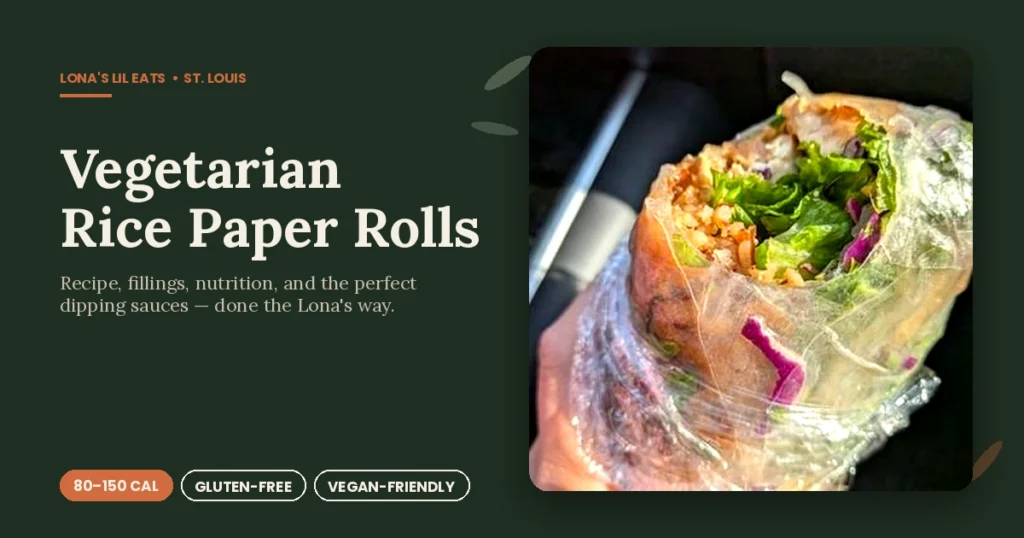
A vegetarian rice paper roll is a fresh, no-cook Asian wrap made from a translucent rice-and-tapioca wrapper filled with raw vegetables, herbs, rice noodles, and a plant-based protein like tofu — all bundled into a roll that runs about 80–150 calories. Naturally gluten-free, low in fat, and high in fiber when packed with vegetables, it is one of the lightest handheld meals in any cuisine.
What Are Vegetarian Rice Paper Rolls? (The Quick Answer)
Vegetarian rice paper rolls — sometimes called summer rolls, fresh spring rolls, or in Vietnamese, gỏi cuốn chay — are translucent wraps assembled around a filling of vegetables, herbs, noodles, and meat-free proteins. Unlike fried egg rolls, they are not cooked. The wrapper is briefly softened in water, then rolled around the filling and served fresh with a dipping sauce.
The vegetarian version swaps the traditional shrimp or pork for tofu, tempeh, mushrooms, avocado, or simply more vegetables.
In short: take a sheet of edible rice paper, fill it with a rainbow of plants, roll it up. That is the dish.
From our kitchen: At Lona’s, the rice paper roll is not a side. Our Giant Rice Paper Wrap is the centerpiece of the menu — built so you can keep it vegetarian, vegan, or omnivore by swapping the protein. Everything below applies whether you’re rolling at home or ordering from us.
Key Statistics: What the Numbers Say
A handful of figures explain why vegetarian rice paper rolls are quietly becoming one of the most-ordered plant-based dishes in the U.S.:
- ~20 kcal: Calories in one 22 cm (~8 inch) rice paper wrapper, dry.
- 80–150 kcal: Calories per finished vegetarian rice paper roll, depending on fillings.
- 2–4 g: Typical fiber per roll when packed with raw vegetables.
- 5–10 g: Plant-based protein in a roll containing tofu, tempeh, or peanut sauce.
- 0 g: Gluten in a standard rice paper wrapper (rice flour + tapioca starch + water + salt).
- ~6%: Share of U.S. adults who identify as vegetarian, per Statista 2025 — and 14% of Gen Z. (Statista)
- 59%: Share of U.S. adults who say they always, sometimes, or usually eat vegetarian meals, per a 2025 YouGov / Vegetarian Resource Group poll. (VRG)
The takeaway: vegetarian rice paper rolls sit at the intersection of three booming trends — plant-based eating, gluten-free demand, and low-calorie convenience.
Are Rice Paper Wrappers Vegetarian (and Vegan)?
Yes — standard rice paper wrappers are naturally vegetarian and vegan. The ingredient list is simple:
- Rice flour
- Tapioca starch (sometimes cassava)
- Water
- Salt
No eggs, no dairy, no animal products of any kind. The wrappers are also typically gluten-free, since they contain no wheat. A handful of imported brands add a small amount of wheat flour for stretchability — read the label if celiac safety matters.
That makes the wrapper itself one of the most universally diet-friendly bases in any cuisine. The filling is what determines whether the finished roll stays vegetarian or not.
Classic Vegetarian Fillings: What Goes Inside
A well-built vegetarian rice paper roll has five components:
- A protein — extra-firm tofu (plain or marinated), tempeh, baked or smoked tofu, edamame, or in fusion versions, a layer of peanut butter.
- A noodle — rice vermicelli (bún) is traditional; glass noodles or thin rice noodles also work.
- Crisp raw vegetables — julienned carrots, cucumber, bell pepper, daikon, purple cabbage, bean sprouts.
- Soft greens and herbs — butter or green leaf lettuce as the base, plus fresh cilantro, Thai basil, mint, or perilla.
- A textural extra (optional) — avocado for creaminess, mango or pineapple for sweetness, crushed peanuts for crunch.
The most-loved pairings in Asian-fusion kitchens:
- Spicy tofu + glass noodles + cucumber + cilantro (Lona’s house profile)
- Mango + avocado + mint + crispy tofu
- Tempeh + carrot + purple cabbage + Thai basil
- Mushroom + rice noodle + perilla + scallion
- Smoked tofu + jicama + cilantro + red bell pepper
The principle: balance soft against crunchy, mild against herbal, light against rich.
How to Make Vegetarian Rice Paper Rolls (Step by Step)
Ingredients (makes 8 rolls):
- 8 rice paper wrappers, 22 cm round
- 200 g extra-firm tofu, sliced into batons and pan-fried or baked
- 100 g rice vermicelli, cooked and cooled
- 1 carrot, julienned
- 1 cucumber, julienned
- 8 large lettuce leaves
- Small bunch of fresh cilantro, mint, and Thai basil
- Optional: ½ avocado, sliced; 1 mango, sliced
Method:
- Prep everything first. All ingredients should be cool and within arm’s reach. Once the wrapper is wet, you cannot pause to chop.
- Soften the wrapper. Fill a wide shallow bowl with warm (not hot) water. Dip one wrapper for 5–10 seconds, until just pliable. It will continue softening as you work — over-soaking guarantees a tear.
- Lay it flat on a clean, slightly damp surface.
- Build the roll. In the lower third of the wrapper, layer: a lettuce leaf, a small mound of vermicelli, two batons of tofu, julienned vegetables, and a few herb leaves.
- Roll tightly. Fold the bottom edge up over the filling, fold both sides inward, then roll forward to seal. The wrapper sticks to itself.
- Serve immediately with dipping sauce, or refrigerate under a damp paper towel for up to two hours.
The technique is the only learning curve. After three rolls, you have the hang of it.
Vegetarian Rice Paper Roll Nutrition: How They Compare
| Feature | Vegetarian Rice Paper Roll | Fried Vegetarian Spring Roll | Veggie Sandwich Wrap |
| Calories per piece | 80–150 kcal | 180–250 kcal | 350–500 kcal |
| Total fat | 1–5 g | 9–14 g | 12–22 g |
| Saturated fat | 0–1 g | 2–4 g | 3–6 g |
| Carbohydrates | 12–20 g | 22–28 g | 35–55 g |
| Dietary fiber | 2–4 g | 1–2 g | 3–6 g |
| Plant protein | 4–10 g | 4–7 g | 10–18 g |
| Gluten | None (standard) | Yes (wheat wrapper) | Yes |
| Cooking method | No cook | Deep-fried | Cold or grilled |
| Added sugar | None | None | Often present |
The pattern is striking: a vegetarian rice paper roll delivers similar protein to a fried spring roll with roughly half the calories and a fraction of the fat. Against a typical lunch wrap, it cuts calories by two-thirds and skips the added sugar entirely.
For a full per-roll breakdown including our giant-size version, see our deep dive on rice paper wraps calories.
Best Dipping Sauces for Vegetarian Rice Paper Rolls
The sauce is half the dish. Five vegetarian-friendly options:
- Peanut hoisin — the most popular pairing. Peanut butter, hoisin, soy sauce, lime, a touch of sriracha. Creamy and sweet-savory.
- Vegan nuoc cham — Vietnamese dipping sauce, plant-built: lime juice, sugar, water, soy sauce (in place of fish sauce), garlic, chili.
- Sweet chili sauce — store-bought is fine; pairs especially well with tofu-heavy rolls.
- Tamari-ginger — tamari, fresh ginger, rice vinegar, sesame oil, a drop of maple syrup.
- Sriracha mayo (vegan) — vegan mayo, sriracha, lime, a pinch of garlic. Western fusion, but addictive.
If you eat strictly gluten-free, double-check the soy sauce — most contain wheat. Tamari is the safe swap.
Common Mistakes to Avoid
- Over-soaking the wrapper. It should be soft to the touch but still slightly firm when you lift it out — it continues softening on the board.
- Overfilling. Rice paper bursts when overstuffed. Less is more.
- Wet vegetables. Pat carrots, cucumber, and tofu dry before assembly, or the roll turns soggy in 30 minutes.
- Hot fillings. Everything should be at room temperature or chilled. Warm tofu or noodles steam the wrapper and weaken it.
- Stacking finished rolls. They stick together permanently. Keep them under a damp towel, separated.
- Skipping the herbs. Cilantro, mint, and Thai basil are not garnish — they are flavor anchors. A roll without herbs tastes flat.
Frequently Asked Questions
Are rice paper rolls always vegetarian?
No. Traditional Vietnamese summer rolls (gỏi cuốn) usually contain shrimp and sometimes pork. The vegetarian version is becoming the default in many American restaurants but is still a choice you make at order time. At Lona’s Lil Eats, our Giant Rice Paper Wrap is built so you choose vegan, vegetarian, or omnivore.
Are vegetarian rice paper rolls healthy?
Yes, by most measures. They are low in calories, low in saturated fat, gluten-free (standard), and high in vegetables. The main nutrition watch-outs are the dipping sauce, which can pack significant sugar and sodium, and the protein level, which can be low if the roll is mostly vegetables and noodles.
How many calories are in a vegetarian rice paper roll?
A typical vegetarian roll runs 80–150 calories, depending on size and fillings. A large “giant” wrap loaded with tofu, avocado, and noodles can reach 250–400 calories. Full breakdown: rice paper wraps calories.
Are rice paper rolls vegan?
The wrapper is vegan. Whether the finished roll is vegan depends on the fillings (no fish-based protein, no egg) and the sauce (no fish sauce, honey, or dairy). Vegan rice paper rolls are easy to build with plant proteins and vegan nuoc cham or peanut hoisin.
Are rice paper wrappers gluten-free?
Standard rice paper wrappers made from rice flour and tapioca starch are gluten-free. Always check the label — a small number of imported brands add wheat flour for stretch.
Can I make vegetarian rice paper rolls ahead of time?
A few hours, yes — store them under a damp paper towel in a single layer in the refrigerator. Beyond that, the wrapper begins to dry, harden, or stick. Best made within two hours of eating.
What is the difference between a rice paper roll and a spring roll?
A rice paper roll (or summer roll) is fresh, uncooked, and wrapped in translucent rice paper. A spring roll is usually fried and wrapped in a wheat-based pastry. The fillings overlap, but the textures and calorie counts diverge dramatically.
Which protein has the most flavor in vegetarian rice paper rolls?
Smoked tofu and marinated baked tofu carry the strongest flavor; tempeh brings nuttiness and bite; mushrooms sautéed in soy and ginger add umami depth. Plain pressed tofu is the most neutral and relies on the sauce.
The Bottom Line
A vegetarian rice paper roll is one of the most efficient meals in any cuisine: low calorie, high in vegetables, gluten-free, no added sugar, and naturally aligned with vegan, flexitarian, and Mediterranean-style eating patterns. The technique is simple enough to master in one sitting, and the variations are nearly endless.
At Lona’s Lil Eats, in St. Louis’s Fox Park neighborhood, the rice paper roll is not a side dish — it is the centerpiece. Our Giant Rice Paper Wrap is built around the same principles laid out above, with full vegetarian and vegan modifications available. Whether you roll at home or come visit, the formula stays the same: rice paper, plants, a great sauce.
Related Reading on Lona’s Lil Eats
- The Original Giant Rice Paper Wrap Recipe
- Rice Paper Wraps Calories: A Full Nutrition Breakdown
- Why a Vegetarian Restaurant in St. Louis Matters
- Lona’s Among the Best Vegan Restaurants in St. Louis
- Thai Cuisine Influences in Our Asian Fusion Menu
- Chinese Cooking Traditions Behind Our Dishes
- The Lona’s Lil Eats Story — From Kunming to Fox Park
- Soulard & Fox Park: Our Neighborhood
- Dine-In & Take-Away Menu
References & Further Reading
- Statista. Veganism and vegetarianism in the United States — statistics & facts (2025). https://www.statista.com/topics/3377/vegan-market/
- Gallup. In U.S., 4% Identify as Vegetarian, 1% as Vegan. https://news.gallup.com/poll/510038/identify-vegetarian-vegan.aspx
- The Vegetarian Resource Group / YouGov. How Many Vegetarians and Vegans Are There in the United States? (2025). https://www.vrg.org/blog/2025/08/08/how-many-vegetarians-and-vegans-are-there-in-the-united-states-2/
- USDA FoodData Central — Nutrient Database. https://fdc.nal.usda.gov/
- Pirelli, J., et al. Diet and Consumer Behavior in U.S. Vegetarians: A NHANES Data Report. NIH PMC. https://pmc.ncbi.nlm.nih.gov/articles/PMC8750925/
- American Heart Association. Healthy Eating Resources. https://www.heart.org/en/healthy-living/healthy-eating
- U.S. Department of Health & Human Services and U.S. Department of Agriculture. Dietary Guidelines for Americans, 2020–2025. https://www.dietaryguidelines.gov/